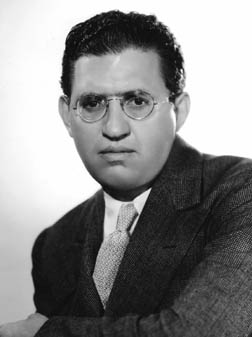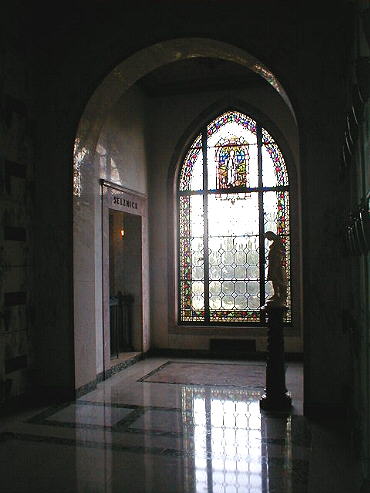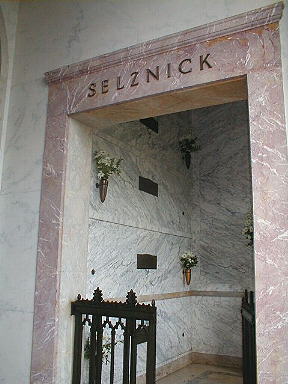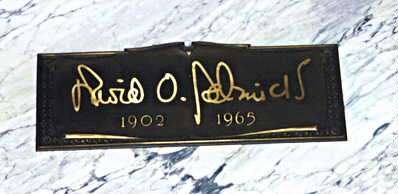
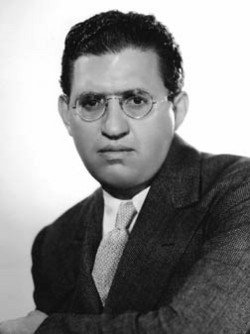
Motion Picture Producer, Studio Executive. He is best remembered for producing the landmark 1939 film, "Gone with the Wind," which earned him an Oscar for Best Picture (the picture also won a total of 8 Oscars plus two special awards). Selznick also won the 1940 Oscar for Best Picture, for the film "Rebecca," being the first producer to win Best Picture Oscars two years in a row. In 1941, Selznick sold off his interest in "Gone with the Wind" for $200,000 to John Hay Whitney, which has to rank as one of his worst decisions, since the film continued to make money in re-releases over the next 50 years. Selznick was born to a Jewish family in Pittsburgh, Pennsylvania, the son of silent-film distributor Lewis J. and Florence A. (Sachs) Selznick. He studied at Columbia University until 1923, when his father went bankrupt. In 1926, he moved to Hollywood, California, and, using his father's connections, got a job as an Assistant Story Editor at MGM Studios. In 1928, he joined Paramount Studios, and, in 1931, joined RKO Studios as Head of Production, each time working hard to move up the company chain. While at RKO, he produced a number of notable films, including "What Price Hollywood" (1932) and "King Kong" (1933). In 1930, he married Irene Mayer, daughter of MGM cofounder, Louis B. Mayer. They would have two children, Daniel and Jeffery, and would divorce in 1948. In 1933, he returned to MGM Studios, where he made several blockbuster films, "Dinner at Eight" (1933), "David Copperfield" (1935), "Anna Karenina" (1935), and "A Tale of Two Cities" (1935). In 1936, he established his own studio, Selznick International Pictures, making such classic films as "The Prisoner of Zenda" (1937), "A Star is Born" (1937), "Intermezzo" (1939), and "Gone With the Wind" (1939). Selznick brought British director Sir Alfred Hitchcock over to Hollywood from England in 1939, and his next Oscar win, "Rebecca" (1940) was Hitchcock's only film to win Best Picture. For the next four years, he took a break from making pictures, renting out his contracted actors such as Ingrid Bergman, Jennifer Jones, Vivien Leigh, and Joan Fontaine to other studios. In 1944, he returned to making films, and his first film, "Since You Went Away" (1944), was a huge success. His 1946 blockbuster film, "Duel in the Sun," was a financial success, although it proved troublesome to the studio to shoot. In the 1950s, he spent an enormous amount of time and money developing the career of his second wife, actress Jennifer Jones, who he had married in 1949. His last film, "A Farewell to Arms," (1957) with Rock Hudson and Jennifer Jones, was not well received, and barely broke even financially. In 1954, breaking from his normal medium, he moved on to television, and made television history when he produced "Light's Diamond Jubilee," which he had shown on all networks simultaneously. Following several heart attacks, he finally retired to his home, where he died of yet another heart attack on June 22, 1965. He once summed up his role of producer, stating, "The way I see it, my function is to be responsible for everything." He was honored with a star on the Hollywood Walk of Fame for his considerable contribution to the motion picture industry.
Motion Picture Producer, Studio Executive. He is best remembered for producing the landmark 1939 film, "Gone with the Wind," which earned him an Oscar for Best Picture (the picture also won a total of 8 Oscars plus two special awards). Selznick also won the 1940 Oscar for Best Picture, for the film "Rebecca," being the first producer to win Best Picture Oscars two years in a row. In 1941, Selznick sold off his interest in "Gone with the Wind" for $200,000 to John Hay Whitney, which has to rank as one of his worst decisions, since the film continued to make money in re-releases over the next 50 years. Selznick was born to a Jewish family in Pittsburgh, Pennsylvania, the son of silent-film distributor Lewis J. and Florence A. (Sachs) Selznick. He studied at Columbia University until 1923, when his father went bankrupt. In 1926, he moved to Hollywood, California, and, using his father's connections, got a job as an Assistant Story Editor at MGM Studios. In 1928, he joined Paramount Studios, and, in 1931, joined RKO Studios as Head of Production, each time working hard to move up the company chain. While at RKO, he produced a number of notable films, including "What Price Hollywood" (1932) and "King Kong" (1933). In 1930, he married Irene Mayer, daughter of MGM cofounder, Louis B. Mayer. They would have two children, Daniel and Jeffery, and would divorce in 1948. In 1933, he returned to MGM Studios, where he made several blockbuster films, "Dinner at Eight" (1933), "David Copperfield" (1935), "Anna Karenina" (1935), and "A Tale of Two Cities" (1935). In 1936, he established his own studio, Selznick International Pictures, making such classic films as "The Prisoner of Zenda" (1937), "A Star is Born" (1937), "Intermezzo" (1939), and "Gone With the Wind" (1939). Selznick brought British director Sir Alfred Hitchcock over to Hollywood from England in 1939, and his next Oscar win, "Rebecca" (1940) was Hitchcock's only film to win Best Picture. For the next four years, he took a break from making pictures, renting out his contracted actors such as Ingrid Bergman, Jennifer Jones, Vivien Leigh, and Joan Fontaine to other studios. In 1944, he returned to making films, and his first film, "Since You Went Away" (1944), was a huge success. His 1946 blockbuster film, "Duel in the Sun," was a financial success, although it proved troublesome to the studio to shoot. In the 1950s, he spent an enormous amount of time and money developing the career of his second wife, actress Jennifer Jones, who he had married in 1949. His last film, "A Farewell to Arms," (1957) with Rock Hudson and Jennifer Jones, was not well received, and barely broke even financially. In 1954, breaking from his normal medium, he moved on to television, and made television history when he produced "Light's Diamond Jubilee," which he had shown on all networks simultaneously. Following several heart attacks, he finally retired to his home, where he died of yet another heart attack on June 22, 1965. He once summed up his role of producer, stating, "The way I see it, my function is to be responsible for everything." He was honored with a star on the Hollywood Walk of Fame for his considerable contribution to the motion picture industry.
Bio by: Kit and Morgan Benson
Family Members


Advertisement
See more Selznick memorials in:
Records on Ancestry

Advertisement